

How each one holds
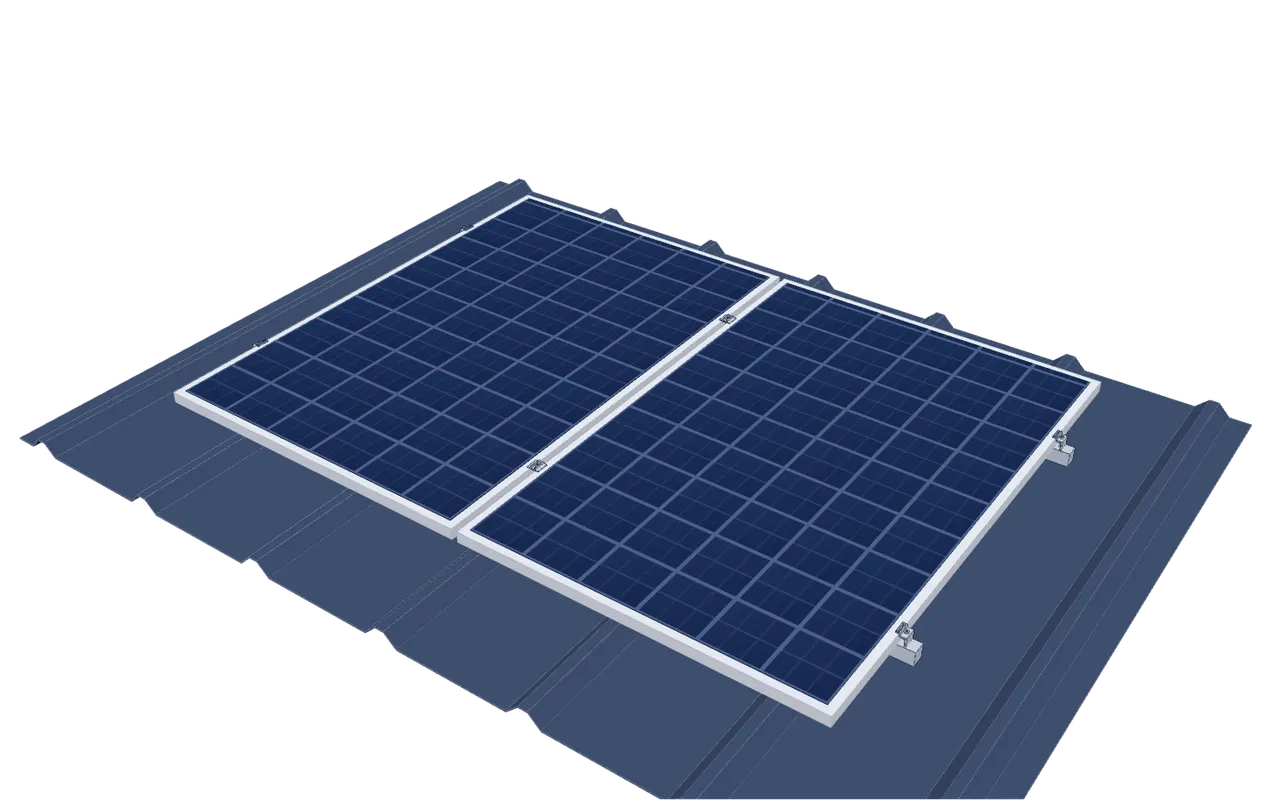
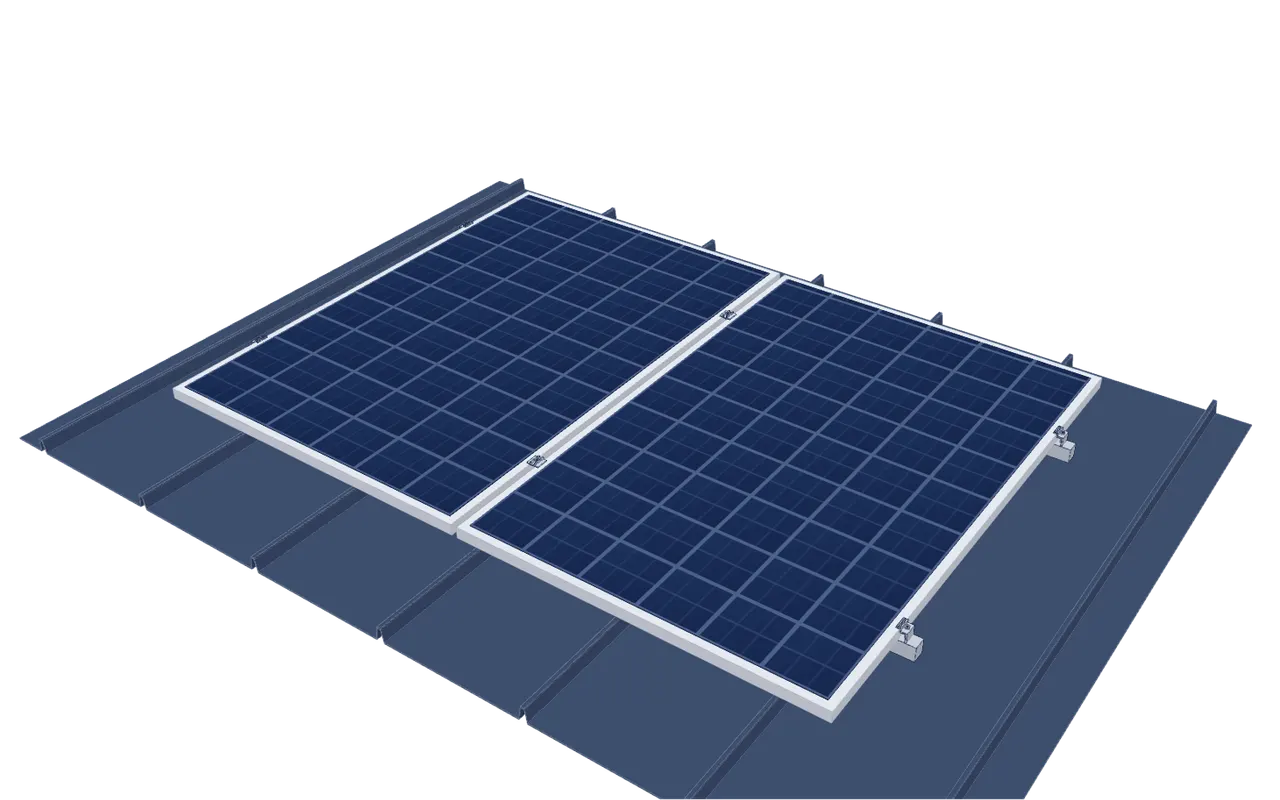
The rib is the raised profile of the roof sheet that the roof clamp grips. A penetrative clamp is fixed through the sheet with self-tapping screws and bonded washers, each tightened until the washer seals; the IBR cleats add an EPDM seal. A non-penetrative clamp grips the rib over a purlin instead, so nothing pierces the roof.
Above the roof the two are identical: rail, splices, and end and inter clamps, in anodised aluminium with stainless steel hardware. The fixing method for each is in its installation manual on the flush mount page.


From the field
For South African roofs, IBR brackets should have rubber seals and never be secured in the valleys. Klip-Lok should be clamped to the ribs without drilling.
The two systems side by side
| Item | Penetrative | Non-penetrative |
|---|---|---|
| Roof sheets | IBR and corrugated | Klip-Lok / Saflok 410 and 700, standing seam, Novotexi 440 |
| Fixing | Self-tapping screws with bonded washers, through the sheet | A clamp on the rib, over a purlin |
| Seal | EPDM, in the IBR cleat kits | Not needed: the sheet is not pierced |
| Before installing | Fix to the manual's method | Accredited on Saflok 700 and 410; otherwise an on-site pull-out test |
| Screws in the warranty | 20 years in C1 to C3; not in C4 or C5 | No screws in the roof |
| Option | Choose this if |
|---|---|
| Penetrative | The roof is IBR or corrugated sheeting, and you want the widest choice of interfaces: cleats, mini rails or L-brackets. Best on inland sites (C1 to C3), where the self-tapping screws are warranted. |
| Non-penetrative | The roof is Klip-Lok/Saflok 410 or 700, standing seam or Novotexi 440, and you want no holes in the sheet. You know the sheet's brand and model, or can arrange a pull-out test. |
Spacing and wind
Both systems are designed for wind regions A to D, with guidance up to a 20 m installation height; above that, a project-specific engineering certificate is needed.
Each system has its own spacing between roof fixings. Spacing is reduced on coastal sites and steeper tilts; we set it per site with our spacing calculator. The figures are in the installation manuals on the flush mount page.
The warranty and the roof
The product warranty covers the mounting structure, not the roof under it: leaks or structural issues from fixing through the roof are excluded, as is a roof whose load capacity has not been assured. The kit must be installed to the manual by qualified personnel.
On a coastal or industrial site, mind the screws: the self-tapping screws in a penetrative fixing are warranted in C1 to C3 only, while anodised aluminium and SUS304 carry 20 years to C4. The corrosion classes guide has the full table.
Tilt kits and flat roofs
Tilt mount comes both ways too: a penetrative base screwed into the purlins over EPDM, or a non-penetrative kit on the Saflok 410/700 cleat, Saflok 410/700 mini-rail clamp tilt support kit or standing seam clamp.
On a flat concrete roof the choice is anchors or ballast. Weighted ballast sits on concrete blocks over EPDM mats with no penetration, and east-west versions need fewer, lighter blocks. Where wind loads are too high, ballast is ruled out, as on the new home in KwaZulu-Natal.
Both, on real roofs
Penetrative on IBR: Truda Foods (2,840 kWp), SAPY Phase 2 (810 kWp) and Pick n Pay, Margate (156.75 kWp). Non-penetrative on Klip-Lok: NutraPharm (880 kWp), The Fields, Hatfield (714 kWp) and Virgin Active, Ballito (290 kWp); on Novotexi 440, The Verve (211 kWp). Non-penetrative mini rails on Klip-Lok: a 2 MWp hybrid rooftop with battery storage in Gauteng, on Saflok 410/700 mini-rail clamp kits that clamp to the roof seams.
What to order
- Penetrative, IBR: LMS-IBR1-KIT-PRO (fixed cleat), LMS-IBR2-KIT-PRO (adjustable cleat) or LMS-MRAIL-PRO-KIT (mini rail).
- Penetrative, corrugated: LMS-COR-MR-KIT (mini rail), LMS-LB-COR-KIT-P or LMS-LB-COR-KIT-L (L-brackets).
- Non-penetrative: LMS-KL1-KIT (Saflok 410/700 cleat), LMS-KL1-MR-KIT (Saflok 410/700 mini-rail clamp kit), LMS-SS-KIT (standing seam), LMS-NVT-KIT (Novotexi 440).
- Non-penetrative tilt: LMS-KL2-MR-TILT-KIT (Saflok 410/700 mini-rail clamp tilt support kit).
Questions
How is a penetrative fixing sealed?
Each clamp is fixed with self-tapping screws and bonded washers, each tightened until the washer seals, and the IBR cleat kits include an EPDM seal. The method is in the installation manual.
Which roof sheets is the non-penetrative clamp accredited for?
Saflok 700 and Saflok 410. For any other sheet, or one you cannot identify, we recommend an on-site pull-out test.
Does the non-penetrative system allow the same spacing?
Each system has its own spacing conditions, set out in its installation manual. We set the spacing for each site with our spacing calculator.
Does the warranty cover roof leaks?
No. It excludes damage to the roof, including leaks from fixing through it, and covers the mounting products against manufacturing defects.
Can a flat concrete roof be done without penetrations?
Yes, with weighted ballast on concrete blocks and EPDM mats. Where wind loads are too high for ballast, the structure is anchored instead.

